


Introduction
Advertising Options for E-commerce Businesses have evolved from simple banner ads to sophisticated, data-driven systems that can target the right customer at the right moment. In today’s competitive digital marketplace, launching an online store is easy — but scaling it profitably is not. Without effective advertising, even high-quality products remain invisible.
Modern e-commerce advertising combines paid media, automation, analytics, creative storytelling, and conversion optimization. Businesses that treat advertising as a strategic growth engine rather than a short-term expense consistently outperform competitors in revenue, brand recognition, and customer loyalty.
Table of Contents
Why Advertising Options Are Important for E-commerce Businesses
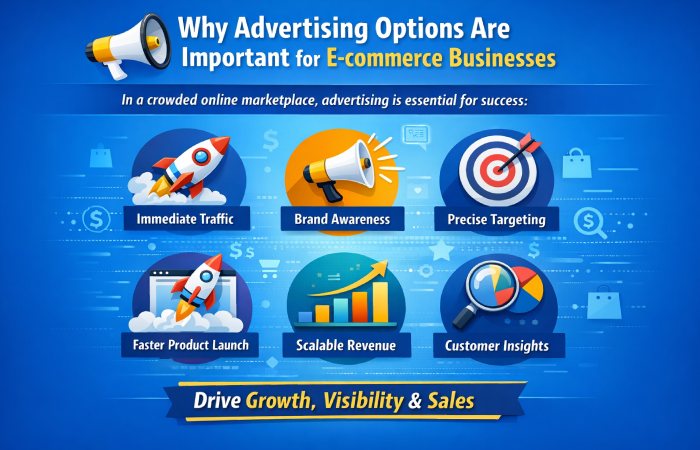
Online retail operates in a crowded environment where thousands of stores compete for the same audience. Advertising provides visibility, differentiation, and traffic flow — the lifeblood of any online store.
Key reasons advertising is essential:
- Immediate traffic generation
- Brand awareness in saturated markets
- Precise audience targeting
- Faster product launches
- Scalable revenue growth
- Data insights into customer behavior
Unlike organic methods that take months to show results, paid advertising can produce measurable outcomes within days.
Ecommerce Advertising Benefits
E-commerce advertising offers advantages that traditional retail marketing cannot match.
| Benefit | Description | Impact on Business |
| Targeted Reach | Ads shown to specific demographics | Higher conversion rates |
| Measurable ROI | Real-time performance tracking | Optimized spending |
| Scalability | Increase budget to grow sales | Predictable growth |
| Retargeting | Re-engage past visitors | Reduced cart abandonment |
| Global Access | Reach international customers | Market expansion |
| Automation | AI-driven campaign management | Lower manual effort |
These benefits make advertising a foundational pillar of successful online retail operations.
Best E-commerce Advertising Strategies
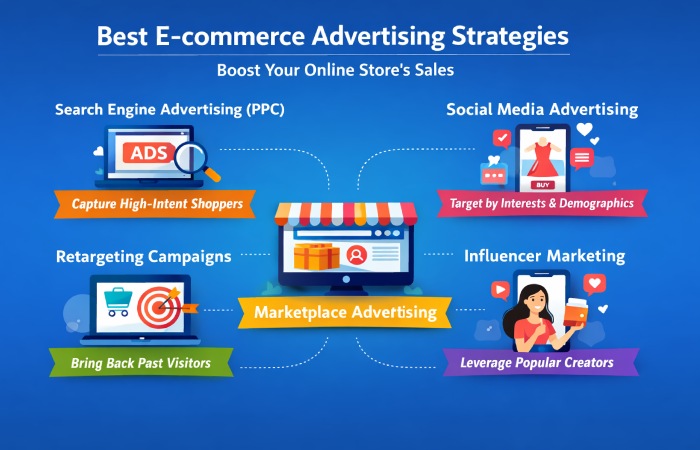
Successful stores rarely rely on a single channel. Instead, they use a diversified strategy tailored to customer behavior.
Search Engine Advertising (PPC)
Pay-per-click ads capture high-intent shoppers actively searching for products.
Best for: Immediate sales
Platforms: Search engines and shopping ads
Strength: Demand capture
Social Media Advertising
Social platforms allow precise targeting based on interests, behaviors, and demographics.
Best for: Brand discovery
Formats: Video ads, carousel ads, story ads, shopping integrations
Strength: Demand creation
Retargeting Campaigns
Retargeting shows ads to users who previously visited your site but did not purchase.
Best for: Conversion recovery
Strength: High ROI, warm audience
Influencer Marketing Ads
Partnering with content creators builds trust and social proof.
Best for: New product launches
Strength: Authentic promotion
Marketplace Advertising
Advertising within large online marketplaces increases product visibility where buyers are already shopping.
Best for: Competitive categories
Strength: High purchase intent
E-commerce Businesses Advertising Agencies Globally
Many companies outsource advertising to specialized agencies for expertise and efficiency.
| Agency Type | Services Offered | Ideal For |
| Performance Marketing Agencies | ROI-focused campaigns | Scaling businesses |
| Full-Service Digital Agencies | Strategy + creative + execution | Established brands |
| Social Media Agencies | Platform-specific campaigns | Lifestyle brands |
| PPC Specialists | Search advertising | Competitive niches |
| Conversion Agencies | Funnel optimization | High traffic stores |
Working with agencies allows businesses to leverage advanced tools, experienced teams, and tested frameworks.
Pricing
Advertising costs vary widely depending on platform, competition, and campaign scope.
| Pricing Model | Typical Structure | Pros | Cons |
| Percentage of Ad Spend | 10–20% of budget | Scales with campaigns | Higher cost at scale |
| Flat Monthly Fee | Fixed retainer | Predictable cost | Less flexibility |
| Performance-Based | Pay per result | Risk reduction | Hard to negotiate |
| Hybrid Model | Fee + performance bonus | Balanced incentives | Complex contracts |
Small stores may start with modest budgets, while large brands invest heavily to dominate market share.
Other Options for E-commerce Business
Beyond mainstream paid advertising, businesses can leverage complementary channels.
- Email marketing campaigns
- SMS promotions
- Affiliate marketing programs
- Content marketing
- SEO for organic traffic
- Referral programs
- Loyalty systems
- Mobile app push notifications
These options often deliver strong long-term returns with lower acquisition costs.
The Difference Between E-commerce Advertising and E-commerce Marketing
Although often used interchangeably, advertising and marketing serve different functions.
| Aspect | Advertising | Marketing |
| Scope | Paid promotion | Overall strategy |
| Goal | Immediate visibility | Long-term growth |
| Channels | Ads platforms | All customer touchpoints |
| Timeline | Short-term results | Sustainable brand building |
| Cost | Direct spend required | Mix of paid & organic |
Advertising is a subset of marketing — powerful but most effective when integrated into a broader strategy.
Ecommerce Sales With Proven Digital Strategies
High-performing e-commerce brands combine multiple tactics into a unified sales system.
Key proven approaches:
- Full-funnel advertising (awareness → consideration → conversion)
- Conversion rate optimization (CRO)
- Personalized product recommendations
- Dynamic pricing strategies
- High-quality product visuals
- Fast checkout processes
- Customer reviews and social proof
When traffic acquisition and conversion optimization work together, revenue grows exponentially.
Future of E-commerce Advertising
The future of Advertising Options for E-commerce Businesses will be shaped by technology, privacy regulations, and changing consumer expectations.
Emerging trends include:
- AI-driven campaign optimization
- Voice search advertising
- Augmented reality shopping ads
- Cookieless targeting solutions
- Predictive personalization
- Programmatic media buying
- Interactive and immersive ads
Businesses that adopt these innovations early will gain significant competitive advantages.
Case Studies
Case Study 1: Startup Fashion Brand
- Strategy: Social media + influencer ads
- Result: Rapid brand awareness and viral growth
- Outcome: Significant increase in first-time customers
Case Study 2: Electronics Store
- Strategy: Search ads + retargeting
- Result: Captured high-intent buyers
- Outcome: Improved conversion rates and ROI
Case Study 3: Home Decor Retailer
- Strategy: Visual shopping ads + email follow-ups
- Result: Higher engagement and repeat purchases
- Outcome: Strong customer lifetime value growth
These examples illustrate that success comes from matching the strategy to the product category and audience behavior.
Conclusion
Advertising Options for E-commerce Businesses are no longer optional — they are essential for survival and growth. From search ads that capture ready-to-buy customers to social campaigns that build brand demand, effective advertising drives traffic, conversions, and long-term loyalty.
The most successful businesses treat advertising as a system rather than a single tactic. By combining multiple channels, optimizing performance continuously, and adapting to emerging technologies, online retailers can achieve sustainable competitive advantage in an increasingly crowded marketplace.
FAQs
1. What is the best advertising platform for e-commerce?
There is no single best platform. Search ads work well for high-intent buyers, while social ads excel at discovery and brand building.
2. How much should an e-commerce business spend on advertising?
Many businesses allocate 10–30% of revenue to marketing, depending on growth stage and competition.
3. Is advertising necessary for small online stores?
Yes. Advertising helps small stores gain visibility quickly and compete with established brands.
4. Which strategy delivers the highest ROI?
Retargeting campaigns often produce the highest ROI because they target users already interested in the product.
5. What is the biggest mistake in e-commerce advertising?
Relying on a single channel instead of building a diversified, data-driven strategy.
