
Class 8 Maths Olympiads are not just academic competitions—they function as early cognitive training systems that build deep problem-solving ability, resilience, and long-term intellectual advantage.
Most students and parents approach Olympiads with the wrong expectation. They ask whether it will improve marks or help in school exams. Appearing in a Class 8 Maths Olympiad is absolutely worth it—but not because of marks or certificates. It is valuable because it fundamentally changes how a student thinks, approaches problems, and learns new concepts.
Olympiads are often treated like just another exam. Students are pushed to prepare, practice, and rank, without understanding the real purpose behind them. This leads to a narrow focus on outcomes instead of learning. The result is unnecessary pressure, dependence on coaching, and missed opportunities to build strong thinking skills.
Table of Contents
Understanding the Difference: School Maths vs Olympiad Maths
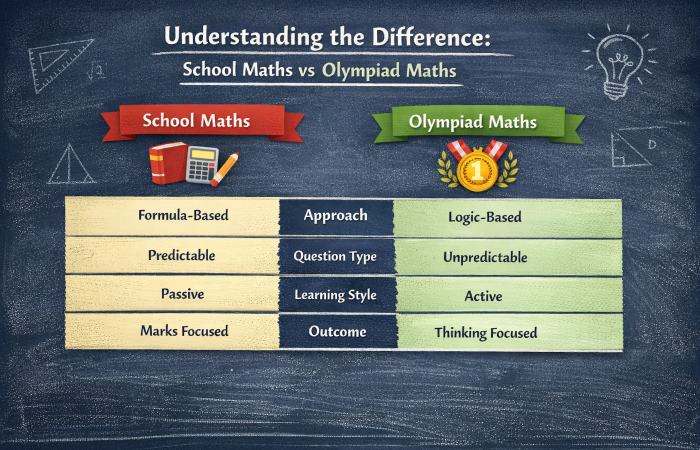
Most of the benefits only make sense when you understand how Olympiad maths differs from school maths. In traditional classrooms, the focus is on completing the syllabus and scoring well in exams. The questions are predictable, methods are predefined, and success depends largely on practice and recall.
Olympiad maths operates on a completely different model. Questions are designed to be unfamiliar, forcing students to think rather than remember. There is no direct formula application. Instead, students must explore patterns, test ideas, and build solutions step by step.
| Aspect | School Maths | Olympiad Maths |
| Approach | Formula-based | Logic-based |
| Question Type | Predictable | Unpredictable |
| Learning Style | Passive | Active |
| Focus | Accuracy | Thinking process |
| Outcome | Marks | Cognitive ability |
This fundamental difference is why Olympiads have a deeper and longer-lasting impact.
Core Framework: How Olympiads Build Thinking Skills
To understand the real benefits, it helps to view Olympiad preparation as a structured cognitive development process rather than random practice. Over time, students build three critical layers of thinking.
| Cognitive Layer | What It Develops | Practical Outcome |
| Conceptual Clarity | Deep understanding of concepts | Less reliance on memorization |
| Problem-Solving Strategy | Logical and analytical thinking | Ability to handle new problems |
| Decision-Making | Time and strategy management | Better performance under pressure |
In practice, this looks very different from school learning. For example, a student solving a complex puzzle may fail multiple times before arriving at the correct solution. Each attempt improves their reasoning ability. This iterative thinking process is what builds long-term intelligence.
10 Benefits of Appearing in Class 8 Maths Olympiad
Deep Conceptual Understanding
Students who prepare for Olympiads move beyond surface-level learning. They begin to understand why mathematical concepts work instead of simply applying them. This leads to stronger retention and better application in higher classes.
| Traditional Learning | Olympiad Learning |
| Memorizes formulas | Understands logic behind formulas |
| Repeats methods | Adapts methods |
| Limited flexibility | High adaptability |
Real Problem-Solving Ability
Olympiads train students to deal with unfamiliar situations. Instead of following a fixed path, they learn to explore multiple approaches. This is similar to real-world problem-solving in fields like engineering and programming.
Research from organizations like the OECD shows that problem-solving skills are a key predictor of future academic and career success.
Early Competitive Advantage
Students who experience difficult questions early develop a natural advantage. When they encounter similar challenges later in school or competitive exams, they find them easier to handle.
| Without Olympiad Exposure | With Olympiad Exposure |
| Struggles with tough questions | Adapts quickly |
| Avoids complex problems | Engages confidently |
| Slower learning curve | Faster progression |
Confidence Through Challenge
Confidence built through solving difficult problems is more meaningful than confidence gained from easy success. Students learn that struggle is part of learning, which reduces fear of failure.
This aligns with the growth mindset theory introduced by Carol Dweck, which emphasizes learning through challenges.
Academic Recognition
Olympiads do provide certificates, ranks, and awards. However, the real value lies in what these achievements represent. They signal strong analytical ability and a willingness to go beyond standard learning.
| Surface Value | Real Value |
| Certificate | Proof of effort |
| Rank | Benchmark of ability |
| Medal | Indicator of consistency |
6. Preparation for other competitions and exams
Writing Olympiads and similar exams at school levels becomes a very good foundation for various other competitive exams and exams of bigger levels for the future. In other words, we can say they act as a stepping stone for other platforms. By doing preparations in various ways and executing them accordingly a student gets to learn many things in this long term process. Thereby this process just does not help in clearing these Olympiads but also in various other future endeavours as well. IMO class 8 2013 question paper is one such great material that students can make use of.
Speed and Accuracy Balance
Olympiads teach students how to manage time effectively while maintaining accuracy. This balance becomes critical in future competitive exams.
| Skill | Impact |
| Time management | Better exam performance |
| Strategic thinking | Efficient problem selection |
| Error reduction | Higher accuracy |
Early Exposure to Advanced Topics
Students are introduced to concepts that are not typically covered in the standard curriculum. This reduces difficulty when they encounter these topics later.
| Topic Area | Benefit |
| Number patterns | Faster understanding of algebra |
| Logical puzzles | Improved reasoning |
| Combinatorics | Advanced problem-solving skills |
Independent Learning Habits
Olympiad preparation encourages students to take ownership of their learning. They begin to explore beyond textbooks and develop curiosity-driven study habits.
| Passive Learning | Active Learning |
| Waits for instruction | Explores independently |
| Follows examples | Creates solutions |
| Limited engagement | Deep involvement |
Identity Shift
One of the most powerful benefits is the change in how students perceive themselves. They begin to identify as problem solvers rather than just learners. This shift influences their behavior and long-term academic choices.
Common Mistakes That Reduce Benefits
Many students fail to gain the full value of Olympiads because of incorrect approaches.
| Mistake | Impact | Solution |
| Over-coaching | Reduces independent thinking | Encourage self-solving |
| Memorizing solutions | Limits understanding | Focus on concepts |
| Inconsistent practice | Slows progress | Maintain routine |
| Rank obsession | Increases stress | Focus on learning |
Is It Worth It? A Decision Framework
Instead of asking whether Olympiads are good or bad, it is better to evaluate them based on the student’s goals and mindset.
| Question | If Yes | If No |
| Is the goal learning? | High value | Limited benefit |
| Is the student curious? | Strong growth | Low engagement |
| Is time available? | Sustainable | Risk of imbalance |
Practical Tips for Beginners
Starting correctly can make a significant difference in outcomes.
| Action | Benefit |
| Build strong basics | Easier progression |
| Practice regularly | Skill improvement |
| Analyze mistakes | Deeper understanding |
| Increase difficulty gradually | Avoid overwhelm |
Example Weekly Plan
| Day | Focus |
| 3 Days | Concept practice |
| 2 Days | Olympiad problems |
| 1 Day | Mistake review |
| 1 Day | Revision |
Conclusion
A Class 8 Maths Olympiad is not about achieving quick success. It is about choosing a more challenging path that leads to long-term growth. Students who approach Olympiads with the right mindset do not just prepare for an exam—they develop the ability to think clearly, solve problems independently, and handle complex situations with confidence.
The real benefit is not the certificate or the rank. It is the transformation in thinking that stays with the student for years.
